
The Transfer Paradox and Instructional Design
Varied Practice Schedules

Introduction
Thinking outside the box sometimes requires us to act counter intuitively. For example, van Merrionboer, De Crock and Jelsma (1997) challenged conventional wisdom by demonstrating, amongst many similar studies, that varied practice schedules lead to more effective learning transfer than blocked practice. That is, making initial practice more difficult in particular ways is to be preferred.
Recap
In previous newsletters, I explored spaced retrieval as a desirable difficulty in instruction. Desirable difficulties, albeit more challenging initially, support better long-term retention as well as transfer of learning (Chen et al., 2018). Spaced retrieval, as an example of a desirable difficulty, is challenging because it requires recalling trace information from long-term memory when a task has not been practiced for some time. However, the extra effort required is worthwhile as it strengthens the memory for performing that task, leading to improved retention.
Varied Practice vs. Blocked Practice Schedules
Varied practice schedules present similar tasks performed in different ways so that initial fluency takes longer to achieve. In contrast, instructional design typically favours blocked practice, where presenting lots of similar tasks performed in the same way means initial fluency is achieved quicker, with less practice items and with less student effort required. Research suggests varied practice schedules, while initially more challenging, are to be preferred as they lead to better transfer of learning to new contexts.

Therefore, while our pursuit of what we consider good instruction makes us lean towards blocked practice schedules, the alternative in the form of varied practice schedules are to be preferred. This week, I’ll delve a little into the learning sciences to explore how the transfer paradox gives support for this counter-intuitive approach, with an example to illustrate what this would look like in practice.
Is efficiency always desirable?
As Kirschener and van Merrienboer (2017) point out, instructional designers often prioritise efficiency through:
minimising practice items,
reducing time spent on practice tasks, and
lessening student effort
in order to meet learning objectives. But is this always the best approach?
Efficiency and Blocked Practice Schedules
As an example of this desired efficiency, if I want students to learn about specific aspects of adding and subtracting integers, I might provide with three distinct (blocked) practice tasks:
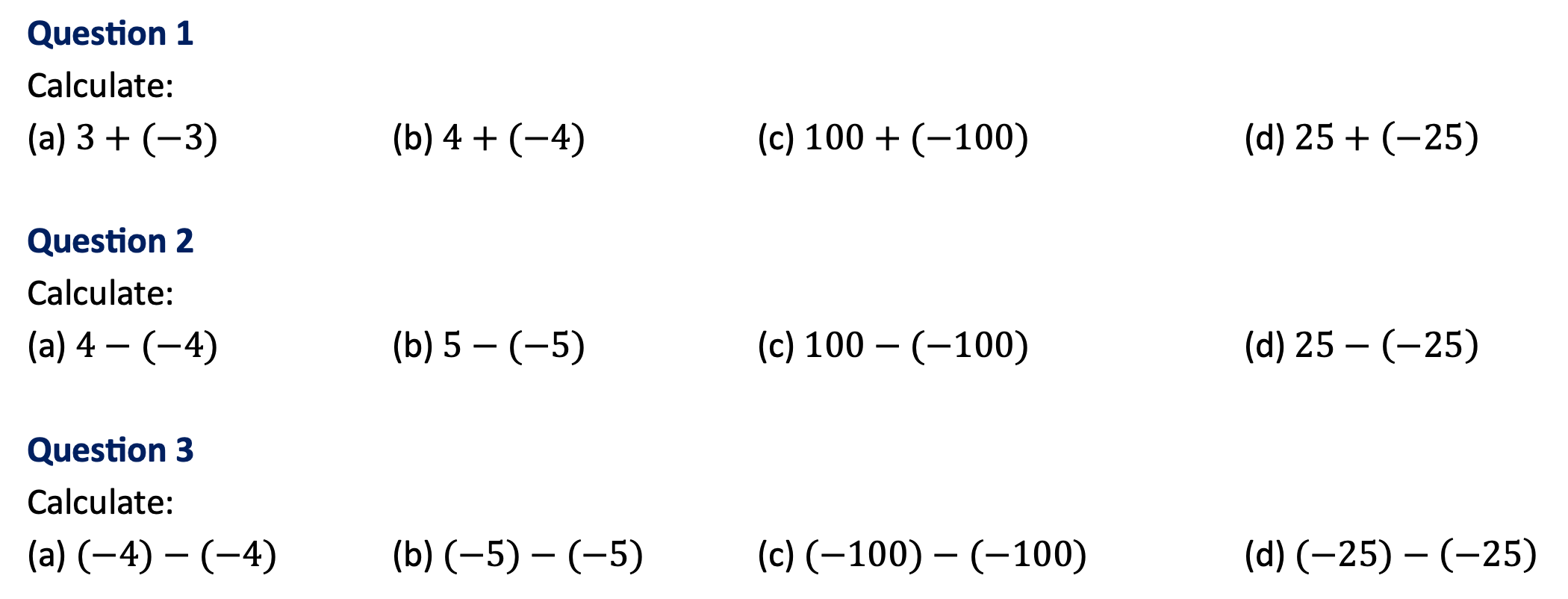
Note in:
Question 1, the answer is always zero.
Question 2, the second number is always added giving a positive answer. And,
Question 3, the second number is always added giving a negative answer.
This blocked practice schedule is more efficient as it allows students to focus on isolated objectives in each separate question and so they can more easily achieve initial fluency. However, it may not help students apply these skills in different contexts as it encourages the construction of specific knowledge that doesn't necessarily transfer beyond the immediate task (Kirschner and van Merrionboer, 2018).
Mixed Practice Schedule
On the other hand, if students were offered a mixed practice schedule, it would require:
a greater number of practice items to reach initial fluency;
more time spent on each task, and
more investment of effort by students to achieve the learning objectives.
A mixed practice schedule could would mix the isolated objectives so that students would have to use more discrimination in each task. This could be done by combining Questions 1 to 3 above and then mixing the order of the parts, as illustrated below:
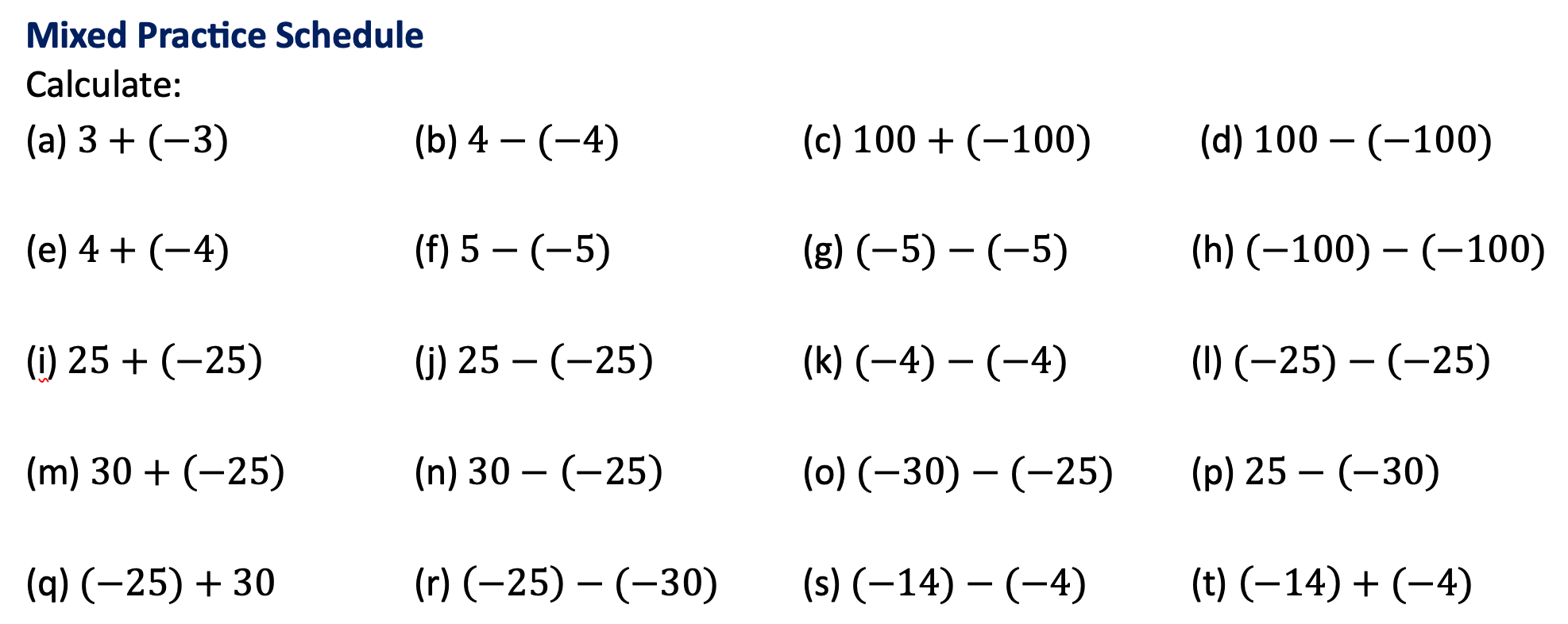
This less efficient method means more practice items will be required to achieve initial fluency, more time will be spent on individual parts as more discrimination is required each time to identify the learning objective, and more effort required from students. However, it supports better transfer of learning, preparing students to apply their learning in unfamiliar scenarios.
Concluding thoughts
Varied practice schedules promote the development of general and abstract knowledge vital for learning transfer. While students may initially make more errors and take longer to achieve fluency, this method equips them better for the complexity of real-world problems. In the next newsletter, I’ll delve a little into the science of how this approach works by considering generalisation and discrimination. Generalisation and discrimination are opposites, but both support the development of sophisticated schema over time.
I'm curious about your experiences. Do you prefer the efficiency of blocked practice, or do you opt for varied practice to cultivate deeper understanding? I look forward to your insights.
References / Further Reading
Bjork, Robert. (2012). Desirable Difficulties: Slowing down learning. GoCognitive, YouTube.
Chen, Ouhao, et al. "Undesirable difficulty effects in the learning of high-element interactivity materials." Frontiers in psychology (2018): 1483.
Perry, T., Lea, R., Jørgensen, C. R., Cordingley, P., Shapiro, K., & Youdell, D. (2021). Cognitive Science in the Classroom. London: Education Endowment Foundation (EEF).
Van Merriënboer, Jeroen JG, Marcel BM De Croock, and Otto Jelsma. "The transfer paradox: Effects of contextual interference on retention and transfer performance of a complex cognitive skill." Perceptual and Motor Skills 84.3 (1997): 784-786.
Van Merriënboer, Jeroen JG, and Paul A. Kirschner. Ten steps to complex learning: A systematic approach to four-component instructional design. Routledge, 2017.
Thank you for presenting this concept with a simple to follow example. Interestingly, I can see this being transferred to topics within Computer Science. For example, when teaching Binary addition, or logical shifts, or binary to hexadecimal conversion. If tasks are designed in the way you propose I foresee a greater degree of challenge and recall which may lead to better retention. Definitely something I shall try.