
Dual Channels for Dual Coding
Optimising Working Memory Capacity

Introduction
This series began by emphasising the importance of cognitive load theory (CLT) for instructional designers, but also discussing why it is insufficient to develop a useful instructional design model:

The second article introduced one component of CLT - extraneous cognitive load – that is, loads inducing cognitive processes in limited working memory that are not relevant to the intended learning. These include, but are not limited to:
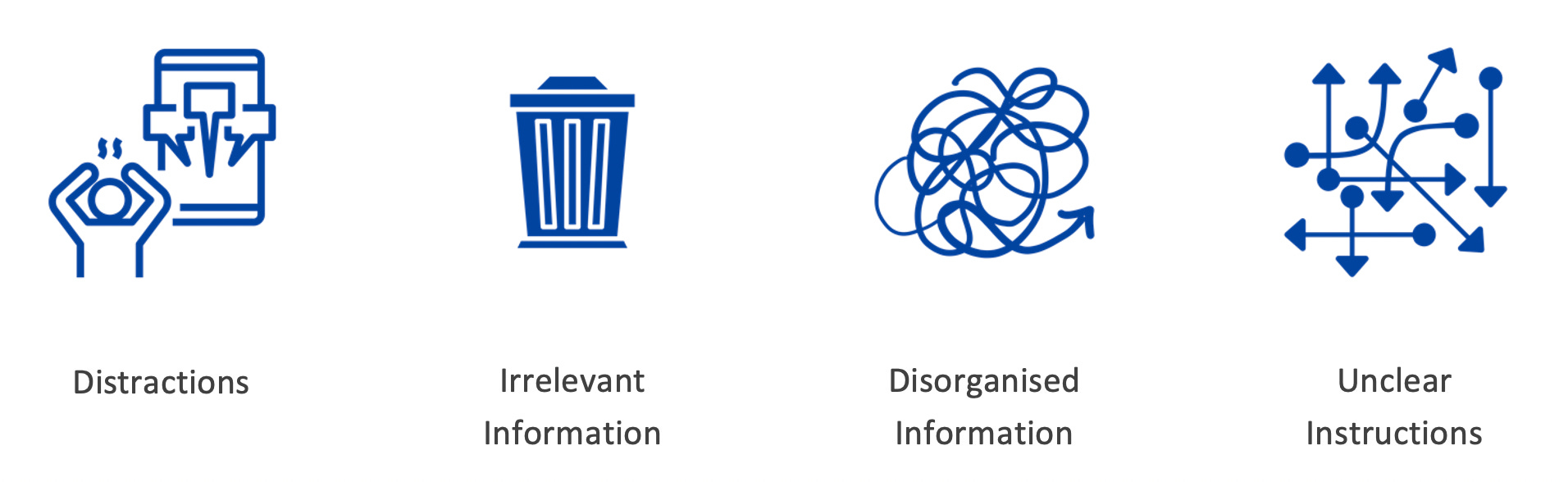
This provided a useful segue into the third article, which discussed how we can frame the efficacy of loads on working memory through the notion of cognitive load effects, using the split-attention effect as a case study. The split-attention effect suggests having to mentally integrate text and image uses limited working memory capacity that could have instead been used for other learning processes. This use represents a form of extraneous cognitive load as the text and image could have instead been presented in an integrated form:
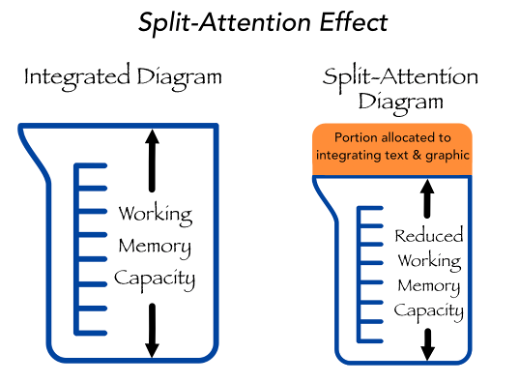
Therefore, discussions so far have noted that:
· working memory capacity is limited;
· extraneous cognitive load requires minimising or eliminating; and
· cognitive load effects describe the efficacy of various instructional approaches.
Next, these three ideas will be linked to an established model of working memory.
Image in Isolation vs. Image with Textual Explanation
Consider the following diagram, which may be used when introducing the Pythagorean Theorem:
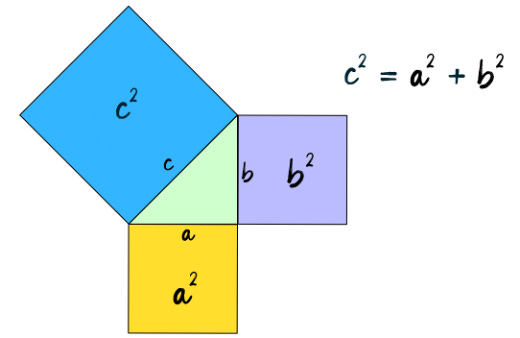
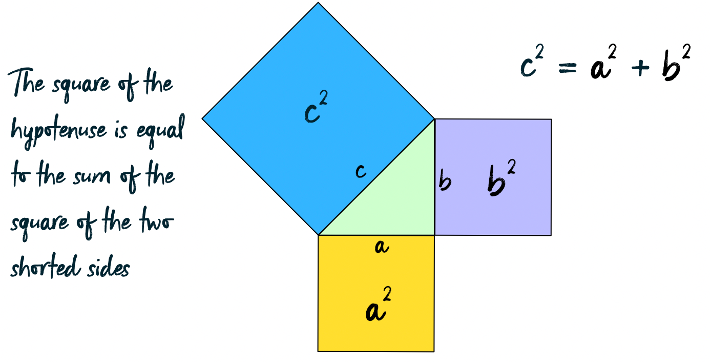
For most, if not all learners, it cannot be understood in isolation, so additional explanation is required. For example, a textual explanation might be presented alongside the image:
Working Memory Channels
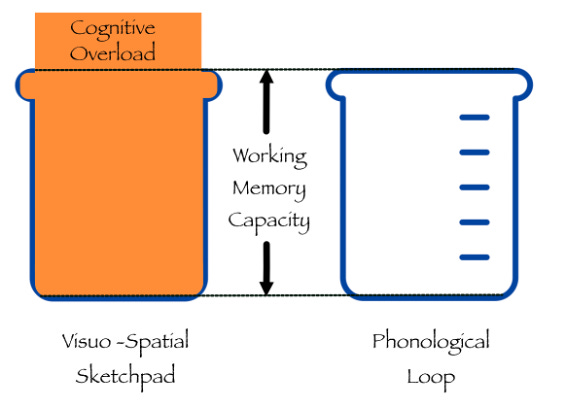
To process the above text and image, humans possess two distinct channels within working memory - one for processing visual information and the other for auditory information1. When the above image is presented alongside a textual explanation, theoretically this only makes use of the visual channel, known as the visuo-spatial sketchpad. In this case the auditory channel, known as the phonological loop, remains unused and this could potentially lead to cognitive overload in the visuo-spatial sketchpad:
Redistributing Working Memory Load
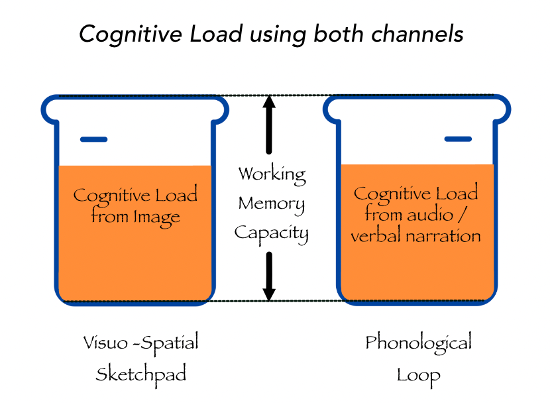
In the Pythagorean example provided above, the teacher could eliminate the text from the image and instead read it out to the students. Or in the case of multimedia presentations, the textual explanation could instead be presented as a recording in the background. In either case, this would theoretically take the load from being solely on the visuo-spatial channel and instead distribute it over two channels, thus effectively expanding the working memory.
Benefits
Presenting information simultaneously in visual and verbal / audio forms, often referred to as dual coding, is thought to make better use of working memory. As cited by Perry et al (2021):
“In Caviglioli (2019, p.20–21), Paul Kirschner describes two main benefits of dual coding. First, he notes that dual coding learning allows the learner to ‘benefit from access to both visual and verbal memory capacity’. Mayer (2021, p.7) describes this benefit as the ‘quantitative explanation’. Second, that coding information produces two information ‘traces’ which, according to Kirschner, (a) will be ‘stronger than one single trace’ and (b) ‘allows you to remember or recognise the information in two different ways’ (Caviglioli, 2019, p.21).”
In other words, working memory is expanded and learning is better encoded.
Limitations
While Kalyuga’s research dates back 20 years and more recently there has been a strong advocacy for dual coding in teacher practice, Perry et al (2021) note that there are few robust tests in the research literature of the theoretical principles being applied in practical settings, and for this reason, firm conclusions are challenging. Therefore, they state the need for nuance, for example, citing a study which suggests that in some application settings dual coding approaches are better for learner understanding (transfer) but not for retention. In their wide-ranging review, they conclude that:
“complexity notwithstanding, there was indicatively supporting evidence … that dual coding and principles from the cognitive theory of multimedia learning [which builds upon dual-coding theory] can be employed to good effect.” Perry et al. (2021)
Concluding Thoughts
With this understanding in mind, it seems working memory capacity can be expanded. Instead of presenting information as image and text, presenting the image with text replaced as audio / verbal commentary makes use of two different channels in working memory – the visuospatial sketchpad and the phonological loop. This approach is referred to as dual coding, with the wider theory in the multimedia context known as the Cognitive Theory of Multimedia Learning.
For the design of instructional materials, a major focus of this series, this means considering how explanatory text should or should not be placed alongside images. In particular, when designing slides for traditional instructional in the classroom, reducing the amount of text on each slide and instead providing verbal explanations seems preferable.
On a personal note, I wish YouTube had been around when I was a student – at least for the plethora of Maths videos that are now readily available on almost every topic. I find videos with audio explanations far superior in helping me revisit an area of Maths or learn a new area than trying to learn from text and accompanying static images alone. For example, if I am looking at an unfamiliar proof for the Pythagorean Theorem, I find it much easier and quicker to watch a video then spend time trying to learn from an image with text. I wonder if this has a relation to the use of dual channels?
How do these insights resonate with your own learning experiences? Share your thoughts – I'm eager to learn from your perspectives!
References / Further Reading
Kalyuga, S. (2000). When using sound with a text or picture is not beneficial for learning
Australian Journal of Educational Technology. 16(2), 161-172,
Perry, T., Lea, R., Jørgensen, C. R., Cordingley, P., Shapiro, K., & Youdell, D. (2021). Cognitive Science in the Classroom. London: Education Endowment Foundation (EEF).
While the initial model proposed by Baddeley and Hitch (1974) proposed two channels, this has been revised (Baddeley, 2012) to suggest there is an additional channel called the episodic buffer. This integrates the information from the visuo-spatial sketchpad and the phonological loop. For the discussions here, the episodic buffer is not directly relevant.