
4 Steps to Getting your Faculty ‘Big Picture Thinking’
Leadership Contingency 6 – Big Picture Thinker

As a leader, can you effectively paint the bigger picture for your faculty? Can each team member see how the dots connect and where they fit in the grand scheme of things? Drawing on the work of Hargreaves and O’Connor (2017), I’d like to delve into four components that can assist you and your faculty in acquiring big picture thinking. Why? Because teams function more effectively when they how the various elements of their work connects together.
In my previous articles on Faculty Leadership, the focus was on Leadership Contingencies for Faculty Leaders. These are behaviours or actions that are essential for Faculty Leaders to cultivate in a school-based context. After discussing being the Sandwiched Negotiator, the importance of a Mediated Vision, the journey towards Uncontrived Collegiality, embracing the role of Faculty Inspector, and the process of innovating by Challenging Mindsets, we now explore Leadership Contingency 6: Big Picture Thinker.

Collaborative Professionalism and Big Picture Thinking
Hargreaves and O’Connor (2017) discuss creating stronger and more effective professional practice through collaboration. Professional collaboration, they argue, may be weak or strong, effective or ineffective, mature or emerging. Collaborative professionalism, on the other hand, means that when teams are working together, they are necessarily creating stronger and better professional practice. Professional collaboration describes what is being done; collaborative professionalism means it is being done in the strongest possible way.
Hargreaves and O’Connor identified ten tenets of collaborative professionalism from their observational research in schools, districts, and collaborative network settings. Tenet 10, ‘Big Picture Thinking for All’, suggests that everyone comprehends the larger context by:
Seeing how everything connects,
Understanding their role within it,
Knowing how they can contribute, and
Gaining clarity on their responsibilities.
Let's consider these four steps one at a time and see how you, as a Faculty Leader, can utilise them to help your team grasp the bigger picture. To illustrate each component, I will use an example of how a Faculty Leader might introduce cognitive science-informed strategies into their faculty's professional development.

1. Connecting the Dots
Cognitive science (cog-sci) approaches in the classroom have gained increased attention since the early 2010s. These approaches include strategies such as spaced learning, retrieval practice, interleaving, and working with schemas, all of which draw from the underlying concept of Cognitive Load Theory (CLT).
Distinguished educator, Professor Dylan Wiliam, underscored the importance of CLT in a 2017 tweet:
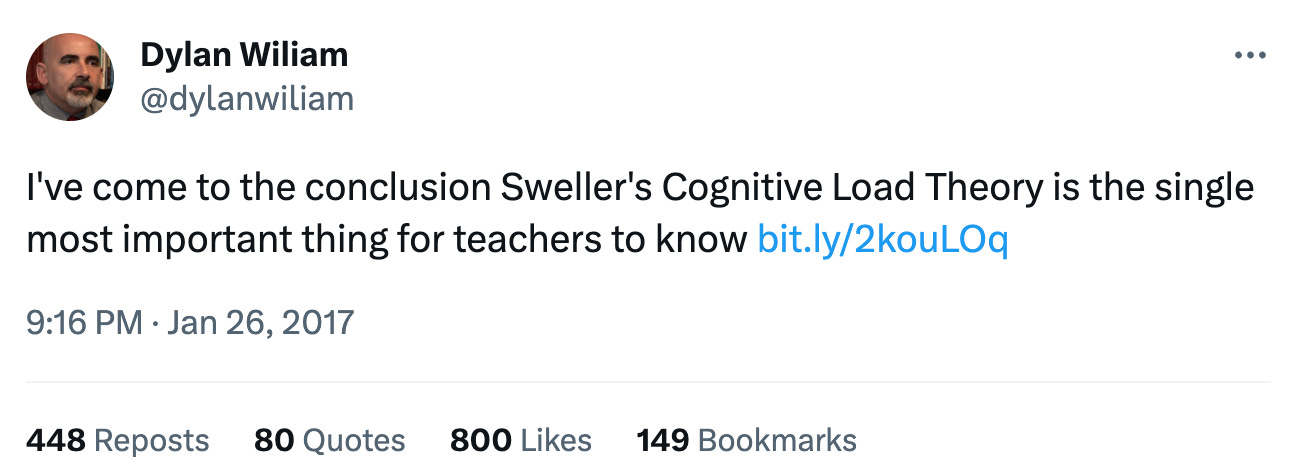
As a Faculty Leader, before introducing professional development on specific instructional strategies derived from CLT, it would be useful to paint the bigger picture first. This could be done by providing a timeline, within a schools context. For example:
(a) Contextualising the theory as emerging in the 1980s from actual observations of students in the classroom, therefore it has a strong empirical basis. Further, that Sweller and others have since worked to develop this research, so we are continually learning in this nascent field.
(b) Showing the popularisation of learning strategies based upon this theory began in earnest with the spread of Rosenshine’s (2012) Principles of Instruction. This made references to working memory, long-term memory, and schema (all concepts related to CLT) and the importance of rehearsal (in other words, retrieval).
(c) Highlighting that Rosenshine (2012) was followed by Dunlosky’s (2013) Strengthening the Student Toolbox, which reviewed the efficacy of learning strategies such as distributed practice and interleaving.
(d) Making mention of the publication of Make it Stick (2014) which helped bring these ideas out of teaching and into the mainstream.
(e) Finally, making mention of the Education Endowment Foundation’s review of the evidence base in its systematic review ‘Cognitive Science Approaches in the Classroom’.
2. Understanding what it means for individual teachers
Presenting the above timeline situates cognitive science approaches within a broader professional context. This understanding is crucial. If teachers perceive these strategies as a significant shift in professional practice, those who fail to adopt these practices might feel 'left behind' professionally.
For instance, the publication of Inside the Black Box by Dylan Wiliam and Paul Black in 1998 emphasised formative assessment as an essential classroom tool. Formative assessment wasn't new at the time, just as cognitive load theory wasn't absent from education prior to the 2010s. However, like formative assessment before it, cognitive load theory is now becoming integrated into core teacher practice. It is therefore critical for teachers to recognise the importance of these evidence-informed and impactful approaches, as their adoption is driven more by classroom colleagues than government policy.
3. Knowing how they can contribute to it
While cog-sci approaches are empirically supported, translating these lab-tested strategies into effective classroom instruction is not straightforward (Davenport, 2020). This difficulty suggests a need for teachers to experiment within a 'tight but loose' framework (Wiliam, 2016) — rigid enough to respect the theory but flexible enough to adapt to their context.
For example, retrieval practice suggests allowing students to ‘forget’ new learning by planning a gap after initial instruction, then retrieving the trace amount that remains in long-term memory. When student responses are then coupled with immediate teacher feedback, this both strengthens the memory and corrects any misconceptions. Teachers might contribute to the implementation of this strategy by experimenting with the length of planned gaps – how long they leave before they test student understanding; the types of student response required (short versus long response questions); when to start varying tasks as students recall improves; and when to start increasing the gap between testing recall. While this is a much evidenced strategy, there is plenty of opportunity for teachers make their own contributions.
4. Knowing where their responsibilities lie
Finally, it is important for teachers to know where their responsibility lies in implementation:
· How often should they practice these cog-sci approaches?
· Should this target a particular cohort, such as an examination group?
· Are they expected to produce resources that will later be shared with colleagues for future use?
· Are they expected to collaborate with colleagues?
As a Faculty Leader, it is important that you are very clear about your expectations for each team member's responsibilities, and ideally, you will negotiate these so that their work capacity is properly managed.
Concluding Thoughts
While I have glossed over some of the finer details of CLT and related cog-sci approaches, it is essential to begin by providing a context that connects the dots; supporting teachers to understand what this means for their practice; offering avenues for them to contribute to the bigger picture; and clarifying their responsibilities. This is not just about becoming a Big Picture Thinker as a Faculty Leader but also about fostering big picture thinking among your colleagues.